
openai agents js
A lightweight, powerful framework for multi-agent workflows and voice agents
Repository Info
About This Server
A lightweight, powerful framework for multi-agent workflows and voice agents
Model Context Protocol (MCP) - This server can be integrated with AI applications to provide additional context and capabilities, enabling enhanced AI interactions and functionality.
Documentation
OpenAI Agents SDK (JavaScript/TypeScript)
The OpenAI Agents SDK is a lightweight yet powerful framework for building multi-agent workflows in JavaScript/TypeScript. It is provider-agnostic, supporting OpenAI APIs and more.
NOTE
Looking for the Python version? Check out Agents SDK Python.
Core concepts
- Agents: LLMs configured with instructions, tools, guardrails, and handoffs.
- Handoffs: Specialized tool calls for transferring control between agents.
- Guardrails: Configurable safety checks for input and output validation.
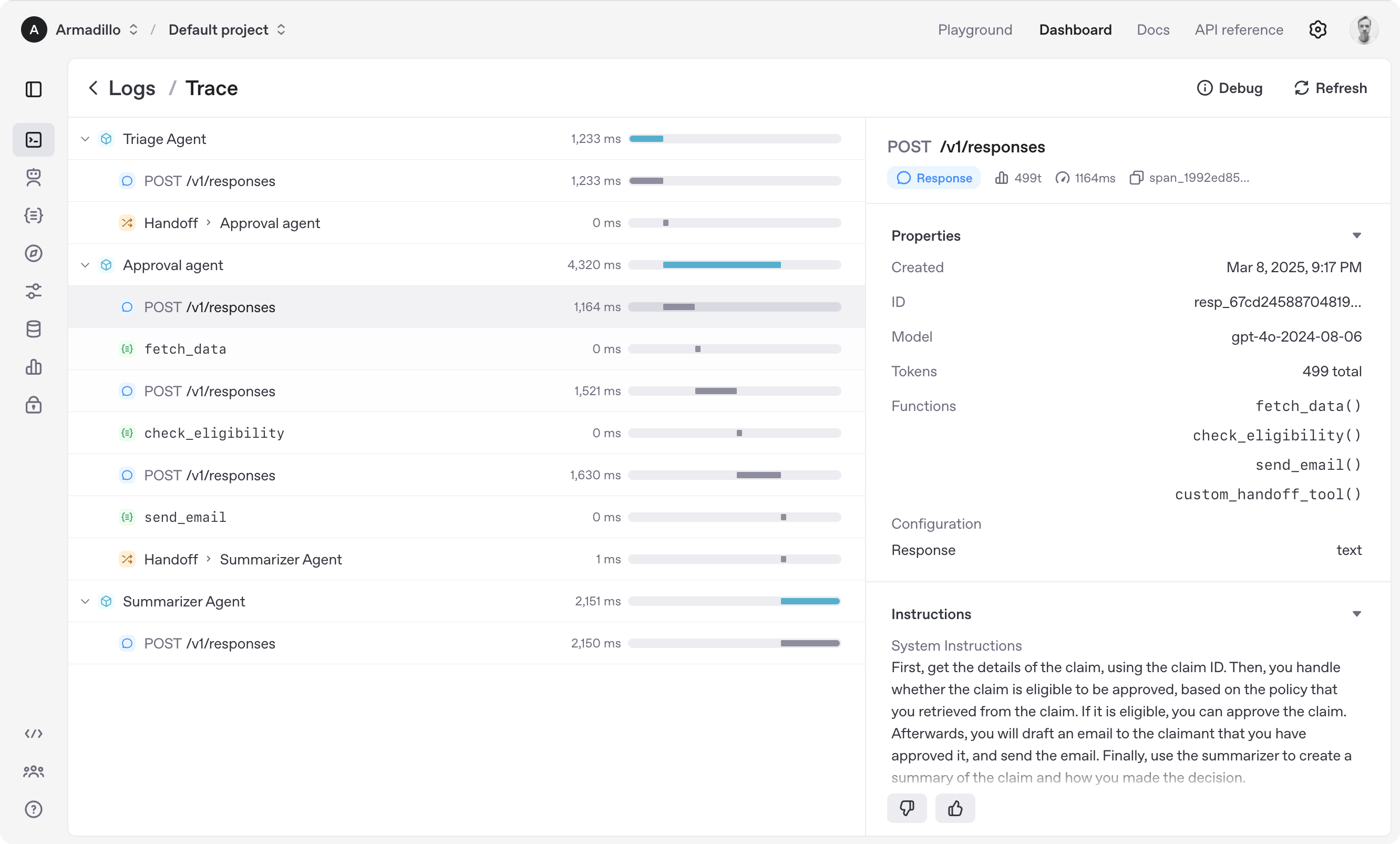
- Tracing: Built-in tracking of agent runs, allowing you to view, debug, and optimize your workflows.
Explore the examples/ directory to see the SDK in action.
Supported Features
- Multi-Agent Workflows: Compose and orchestrate multiple agents in a single workflow.
- Tool Integration: Seamlessly call tools/functions from within agent responses.
- Handoffs: Transfer control between agents dynamically during a run.
- Structured Outputs: Support for both plain text and schema-validated structured outputs.
- Streaming Responses: Stream agent outputs and events in real time.
- Tracing & Debugging: Built-in tracing for visualizing and debugging agent runs.
- Guardrails: Input and output validation for safety and reliability.
- Parallelization: Run agents or tool calls in parallel and aggregate results.
- Human-in-the-Loop: Integrate human approval or intervention into workflows.
- Realtime Voice Agents: Build realtime voice agents using WebRTC or Websockets
- Local MCP Server Support: Give an Agent access to a locally running MCP server to provide tools
- Separate optimized browser package: Dedicated package meant to run in the browser for Realtime agents.
- Broader model support: Use non-OpenAI models through the Vercel AI SDK adapter
- Long running functions: Suspend an agent loop to execute a long-running function and revive it later
- Voice pipeline: Chain text-based agents using speech-to-text and text-to-speech into a voice agent

Get started
Supported environments
- Node.js 22 or later
- Deno
- Bun
Experimental support:
- Cloudflare Workers with
nodejs_compatenabled
Check out the documentation for more detailed information.
Installation
This SDK currently does not work with zod@3.25.68 and above. Please install zod@3.25.67 (or any older version) explicitly. We will resolve this dependency issue soon. Please check this issue for updates.
npm install @openai/agents 'zod@<=3.25.67'
Hello world example
import { Agent, run } from '@openai/agents';

const agent = new Agent({
  name: 'Assistant',
  instructions: 'You are a helpful assistant',
});

const result = await run(
  agent,
  'Write a haiku about recursion in programming.',
);
console.log(result.finalOutput);
// Code within the code,
// Functions calling themselves,
// Infinite loop's dance.
(If running this, ensure you set the OPENAI_API_KEY environment variable)
Functions example
import { z } from 'zod';
import { Agent, run, tool } from '@openai/agents';

const getWeatherTool = tool({
  name: 'get_weather',
  description: 'Get the weather for a given city',
  parameters: z.object({ city: z.string() }),
  execute: async (input) => {
    return `The weather in ${input.city} is sunny`;
  },
});

const agent = new Agent({
  name: 'Data agent',
  instructions: 'You are a data agent',
  tools: [getWeatherTool],
});

async function main() {
  const result = await run(agent, 'What is the weather in Tokyo?');
  console.log(result.finalOutput);
}

main().catch(console.error);
Handoffs example
import { z } from 'zod';
import { Agent, run, tool } from '@openai/agents';

const getWeatherTool = tool({
  name: 'get_weather',
  description: 'Get the weather for a given city',
  parameters: z.object({ city: z.string() }),
  execute: async (input) => {
    return `The weather in ${input.city} is sunny`;
  },
});

const dataAgent = new Agent({
  name: 'Data agent',
  instructions: 'You are a data agent',
  handoffDescription: 'You know everything about the weather',
  tools: [getWeatherTool],
});

// Use Agent.create method to ensure the finalOutput type considers handoffs
const agent = Agent.create({
  name: 'Basic test agent',
  instructions: 'You are a basic agent',
  handoffs: [dataAgent],
});

async function main() {
  const result = await run(agent, 'What is the weather in San Francisco?');
  console.log(result.finalOutput);
}

main().catch(console.error);
Voice Agent
import { z } from 'zod';
import { RealtimeAgent, RealtimeSession, tool } from '@openai/agents-realtime';

const getWeatherTool = tool({
  name: 'get_weather',
  description: 'Get the weather for a given city',
  parameters: z.object({ city: z.string() }),
  execute: async (input) => {
    return `The weather in ${input.city} is sunny`;
  },
});

const agent = new RealtimeAgent({
  name: 'Data agent',
  instructions: 'You are a data agent',
  tools: [getWeatherTool],
});

// Intended to be run the browser
const { apiKey } = await fetch('/path/to/ephemerial/key/generation').then(
  (resp) => resp.json(),
);
// automatically configures audio input/output so start talking
const session = new RealtimeSession(agent);
await session.connect({ apiKey });
Running Complete Examples
The examples/ directory contains a series of examples to get started:
pnpm examples:basic- Basic example with handoffs and tool callingpnpm examples:agents-as-tools- Using agents as tools for translationpnpm examples:web-search- Using the web search toolpnpm examples:file-search- Using the file search toolpnpm examples:deterministic- Deterministic multi-agent workflowpnpm examples:parallelization- Running agents in parallel and picking the best resultpnpm examples:human-in-the-loop- Human approval for certain tool callspnpm examples:streamed- Streaming agent output and events in real timepnpm examples:streamed:human-in-the-loop- Streaming output with human-in-the-loop approvalpnpm examples:routing- Routing between agents based on language or contextpnpm examples:realtime-demo- Framework agnostic Voice Agent examplepnpm examples:realtime-next- Next.js Voice Agent example application
The agent loop
When you call Runner.run(), the SDK executes a loop until a final output is produced.
- The agent is invoked with the given input, using the model and settings configured on the agent (or globally).
- The LLM returns a response, which may include tool calls or handoff requests.
- If the response contains a final output (see below), the loop ends and the result is returned.
- If the response contains a handoff, the agent is switched to the new agent and the loop continues.
- If there are tool calls, the tools are executed, their results are appended to the message history, and the loop continues.
You can control the maximum number of iterations with the maxTurns parameter.
Final output
The final output is the last thing the agent produces in the loop.
- If the agent has an
outputType(structured output), the loop ends when the LLM returns a response matching that type. - If there is no
outputType(plain text), the first LLM response without tool calls or handoffs is considered the final output.
Summary of the agent loop:
- If the current agent has an
outputType, the loop runs until structured output of that type is produced. - If not, the loop runs until a message is produced with no tool calls or handoffs.
Error handling
- If the maximum number of turns is exceeded, a
MaxTurnsExceededErroris thrown. - If a guardrail is triggered, a
GuardrailTripwireTriggeredexception is raised.
Documentation
To view the documentation locally:
pnpm docs:dev
Then visit http://localhost:4321 in your browser.
Development
If you want to contribute or edit the SDK/examples:
-
Install dependencies
pnpm install -
Build the project
pnpm build -
Run tests, linter, etc. (add commands as appropriate for your project)
Acknowledgements
We'd like to acknowledge the excellent work of the open-source community, especially:
- zod (schema validation)
- Starlight
- vite and vitest
- pnpm
- Next.js
We're committed to building the Agents SDK as an open source framework so others in the community can expand on our approach.
For more details, see the documentation or explore the examples/ directory.
Quick Start
Clone the repository
git clone https://github.com/openai/openai-agents-jsInstall dependencies
cd openai-agents-js
npm installFollow the documentation
Check the repository's README.md file for specific installation and usage instructions.
Repository Details
Recommended MCP Servers
Discord MCP
Enable AI assistants to seamlessly interact with Discord servers, channels, and messages.
Knit MCP
Connect AI agents to 200+ SaaS applications and automate workflows.
Apify MCP Server
Deploy and interact with Apify actors for web scraping and data extraction.
BrowserStack MCP
BrowserStack MCP Server for automated testing across multiple browsers.
Zapier MCP
A Zapier server that provides automation capabilities for various apps.